Introducing Getcodexa: A Better Way to Reinforce ICD-10 Learning for Adult Learners
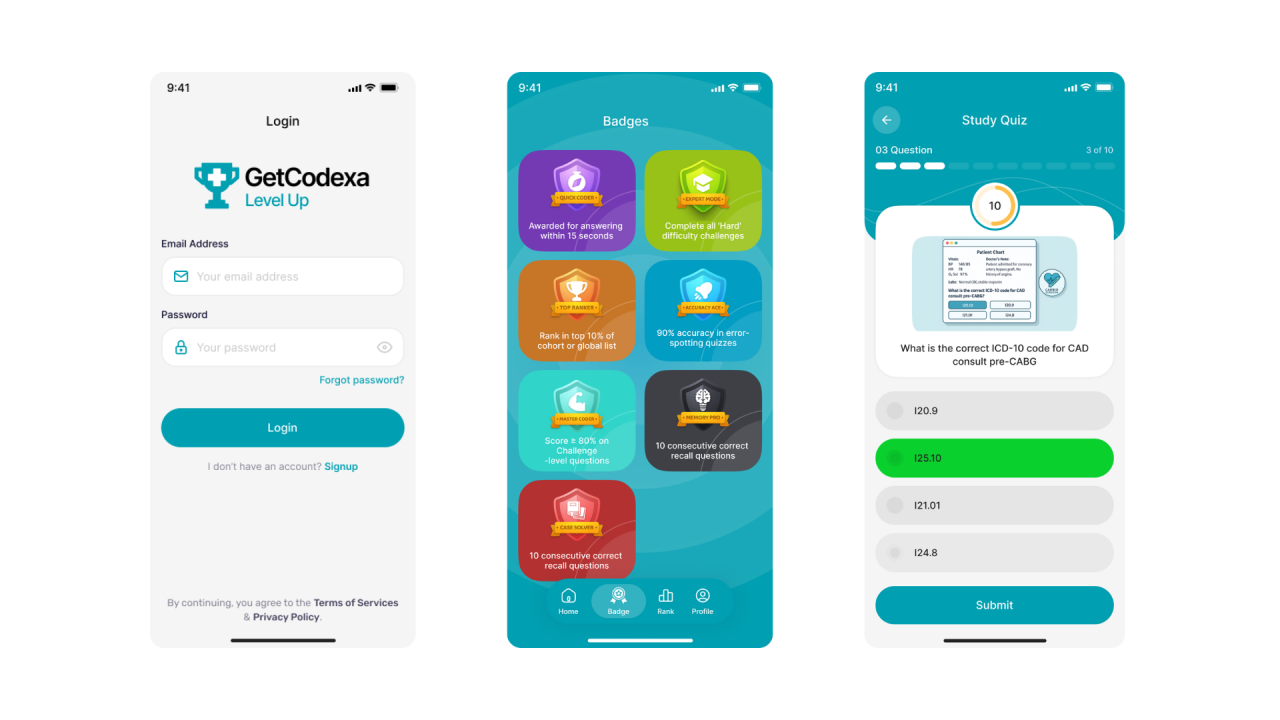
Medical coding sits at the center of healthcare accuracy, compliance, and reimbursement. Yet ICD-10… often feels overwhelming to new learners — especially adults returning to education after years in the workforce. With more than 70,000 diagnosis codes and strict sequencing rules, ICD-10 demands not just knowledge, but clarity and consistency.
The stakes for accuracy are high. Incorrect or incomplete coding contributes to significant financial loss across the healthcare system every year. According to the U.S. Department of Health and Human Services (HHS), Medicare Fee-for-Service had an improper payment rate of 7.38% in 2023, representing $31.2 billion in lost or incorrect reimbursements. Many of these improper payments result from documentation and coding inaccuracies — issues that impact hospitals, payers, and ultimately, patient outcomes.
Given this context, it is understandable why new ICD-10 learners often feel pressure to “get it right” quickly. But the real barrier to progress isn’t usually the content itself — it is the lack of predictable, structured reinforcement to help learners understand how the system works. Without repeated exposure, patterns don’t have time to solidify.
Traditional study methods tend to rely heavily on memorization, long reading sessions, or isolated code lists. These approaches frequently fail adult learners who need clarity, context, and logical structure. ICD-10 was not designed to be memorized. It was designed to be navigated.
This is the philosophy behind Getcodexa, a learning reinforcement tool built specifically to help learners strengthen what they are already being taught in ICD-10 programs. Getcodexa is not a replacement for instruction, textbooks, or certified educators. Instead, it provides the structure, consistency, and guided practice that help learners transform classroom knowledge into lasting skill. The goal is to strengthen — not duplicate — what instructors already teach.
One of the first challenges new coders face is understanding the hierarchy of ICD-10: chapters, categories, subcategories, and code-level details. Once learners grasp this structure, new information becomes easier to interpret. ICD-10 starts to feel less like a maze and more like a system. Patterns emerge. Logic becomes clearer. And the sheer volume of information feels more manageable.
Getcodexa supports this process by reinforcing a step-by-step progression. Learners begin by strengthening their understanding of chapters — the broadest level of ICD-10 — and then move into categories and subcategories, applying the concepts through short, structured practice moments. Rather than overwhelming learners with long study blocks, Getcodexa focuses on consistency: brief, repeated interactions that help concepts stick.
For adult learners, this approach is especially important. Many are balancing work, family responsibilities, and career transitions. They often study in short intervals, making it difficult to retain information through traditional methods. A learner studying in 10-minute pockets can still make meaningful progress with the right structure. A structured reinforcement tool allows them to build understanding gradually, without cognitive overload.
Educators also benefit from this model. Many instructors observe that new students enter coding programs without a strong understanding of ICD-10 structure, which slows classroom progress and increases early frustration. When learners reinforce foundational concepts outside the classroom, they arrive more confident and ready for applied learning. This allows instructors to move more efficiently into applied coding, case scenarios, and real-world decision-making.
The team behind Getcodexa includes experienced professionals in revenue cycle management, healthcare compliance, and coding education. Their direct experience with both learner challenges and industry-wide financial loss from coding inaccuracies informed the platform’s design. They recognized that reducing coding errors — and the billions of dollars associated with them — starts with building stronger foundations early. The platform integrates both industry standards and proven adult-learning principles.
For individuals preparing to enter ICD-10 programs in 2025–2026, Getcodexa offers a way to strengthen understanding before the first day of class. For returning adult learners, it reduces intimidation and builds confidence through predictable, structured reinforcement. And for educators and training programs, it provides a clearer picture of learner progress and areas needing additional support.
ICD-10 may be complex, but with the right structure and consistent practice, it becomes far more accessible. Getcodexa was built to support that transformation.
To explore how Getcodexa can support your learning or your program, you can preview the platform at www.getcodexa.com.